

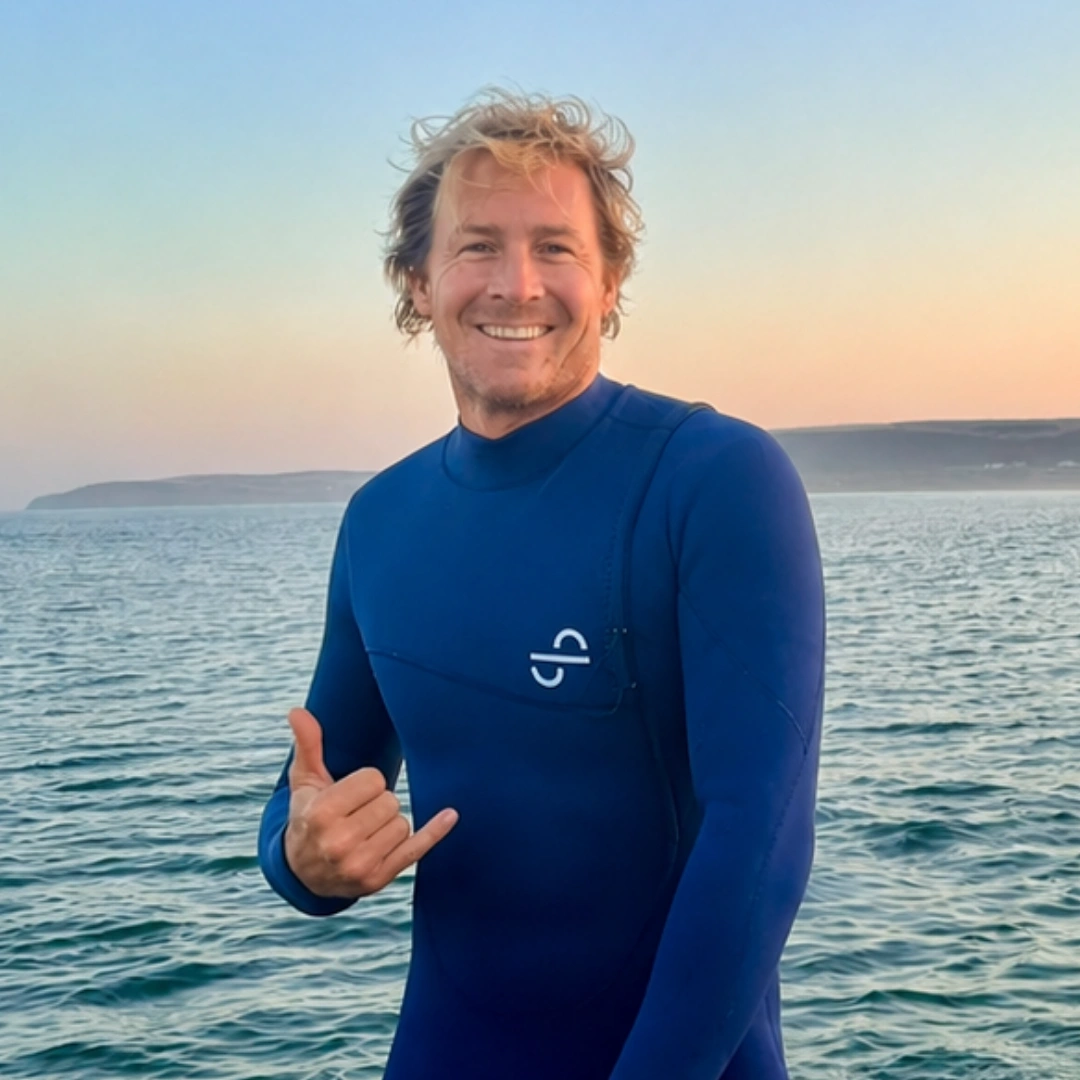
andrew “cotty” cotton
Andrew “COTTY” Cotton
Introduction
Introduce yourself — your name, where you’re based, and what surfing means to you in one word.
I’m Andrew Cotton — Cotty to most people. I split my time between North Devon in the UK and Nazaré in Portugal. Surfing, in one word: freedom.
The Ocean & Surfing
1. What is your local break, and what does that place mean to you?
My local break is Saunton Sands in Devon. It’s a stunning stretch of coastline, and it’s where it all started for me — a beautiful place that means a huge amount to me.
2. You’ve surfed some of the biggest waves on the planet. What is it about big waves that keeps you excited?
It’s about pushing personal boundaries — doing things I didn’t think I’d be able to do. That’s genuinely exciting. The key is not getting too caught up in it, but the opportunity to push myself as hard as I have is what keeps me coming back.
3. Can you remember the first time you experienced a wave that genuinely scared you? What did you learn from it?
I can’t pin down one specific moment — I think I’ve always felt fairly fearless in the water. But the reality is, it’s a scary pursuit. What it’s taught me is that some magic things can happen on the other side of fear. There’s a real feeling of reward in pushing through it.
4. What does the ocean teach you that you don’t think you could learn anywhere else?
How insignificant we are. You can never beat the ocean — it makes you feel small, and honestly, I like that about it.
5. After all these years, do you think you understand the ocean — or do you feel you understand how little you actually understand?
It’s continuous — a lifetime of learning that never really ends. That’s exactly why we keep doing this: because there’s always more to learn.
Risk, Equipment & Performance
6. When you’re being towed into a serious wave, how much of your confidence comes from your own ability, and how much comes from trusting your equipment?
It all adds up. When I’m putting everything on the line, I need confidence in my own ability, but the equipment is just as important. Any doubt at all is dangerous. I need to know I’ve done everything I can physically, and that my gear is the best it can be — because that’s what gets me through those situations.
7. What makes a piece of surf equipment genuinely exceptional in your eyes?
Trust that it will outperform — even by just one percent — and durability, knowing it will last. Ultimately it comes down to anything that feeds my confidence. Having the best equipment does exactly that.
8. What’s something about wetsuits or surf equipment that you think most surfers don’t understand until they’ve experienced it at the highest level?
A lot of people settle for “not quite right” without realising it. I’ve spent years and years learning how to ride the biggest waves and perform at my best, and I know the finer details make the difference. I don’t want to settle for mediocre — I want the best, full stop.
9. When conditions become extreme, what separates equipment that simply works from equipment you can genuinely trust with your life?
It goes back to that same mindset — if I have any doubt, it’s dangerous, and on the biggest days, when everything matters, I need equipment I know is tested and proven. That’s what feeds the right mindset going into it.
10. Having spent decades testing equipment in some of the harshest conditions imaginable, what do you think the surf industry could be doing better?
The industry always needs people pushing it forward — always looking for marginal gains, because everything is constantly evolving. I do feel the surf industry can be slow to change and develop. But that’s exactly what it needs — everything can always be improved or tweaked. That’s how it evolves.
The Future
11. Surfing equipment has changed dramatically during your career. Where do you think the next major breakthroughs will come from?
Materials. It’s already starting to happen a little, but that’s where the next major breakthroughs will be.
12. Do you think the industry has become too focused on making more products, rather than making fewer products that are genuinely better?
Yes — it’s evident. There are more products, more things to sell, but is it actually any better? No. I think that’s definitely a problem.
13. What does innovation actually mean to you? Is it about new materials and technology, or is it about solving problems surfers genuinely have?
I think it goes hand in hand — sometimes you don’t even realise something’s a problem until you’re testing and trying to improve it. But the key is having the time to properly test products, so they don’t just work, but are genuinely functional and last.
14. If you could design the perfect wetsuit for a surfer — with no limitations on materials, technology or cost — what would it do?
I’d want to build more safety equipment directly into the wetsuit itself, rather than adding it in layers. Big wave and tow surfing already involves so much gear that it can be hard to move — so my dream would be a kind of built-in survival suit, without the bulk.
The Ocean
15. You’ve spent more time in the ocean than most people could imagine. What changes have you personally noticed in the ocean or coastlines during your lifetime?
One thing I’ve noticed is that it’s become busier and more popular — which is amazing in its own way.
16. What responsibility do surfers have towards the ocean that gives us so much?
It’s like keeping your own back garden tidy — everyone needs to do their bit. That’s not just about your own actions, either; it’s about teaching the next generation to do the same. It ranges from keeping your local area tidy to genuinely looking after the places we surf.
17. What do you think the surf industry could be doing better to protect the environment it depends upon?
It’s a tough one to get drawn into. Every industry has a difficult line to walk, and I don’t think it’s fair to pick faults with the surf industry specifically — manufacturing, importing, exporting, it’s a genuinely tough business to get right. To be fair, I think it does pretty well.
18. Are there any people, brands, organisations or projects you’ve encountered that genuinely give you hope for the future of our oceans?
There are so many awareness groups and charities, even just in my local area — it’s honestly amazing how much is out there. People are passionate about it, they understand it, and they’re promoting it. All those smaller organisations give me hope.
Personal
19. You’ve experienced some extraordinary highs — and some very serious lows. Has your relationship with surfing changed as you’ve got older?
Now it’s about enjoying every swell like it might be the last. I’m not out there to prove anything or win anything anymore — just to enjoy it.
20. What does success mean to you now compared with when you were younger?
Success, for me, has been turning my hobby and my passion into a career.
21. If you could go back and speak to yourself when you first started surfing, what would you tell him?
It’s a long journey. People will tell you it’s not possible or that it can’t be done. Don’t forget to enjoy it.
22. What’s the one wave, session or moment in your career that you’ll never forget? Why?
One of my first big waves at Mullaghmore, back in 2012. Definitely one of the best waves I’ve ever had.
Final — The Hero Question
23. If you could leave one message with the next generation of surfers, what would you want them to understand about the ocean, surfing and the way we interact with it?
Don’t take it for granted.
Additional: Technical / Wetsuit Fit Questions
What do you notice most about wetsuit fit when you’re in the water?
The heat generated around the chest area from the lining — how much warmth that generates is the thing I notice most.
Where does restriction or poor fit matter most when surfing?
Popping up. If the suit doesn’t fit right, it makes even simple movements hard.
When you’re surfing somewhere like Nazaré, what do you actually need from a wetsuit?
Durability, above all — the suits take a real beating out there — and warmth.
What happens when equipment doesn’t perform properly in serious conditions?
It becomes a risk. If you’re not warm, or the equipment fails, you risk missing the wave entirely.
How important are warmth and comfort during long sessions or extended periods in the water?
As soon as you start getting cold, your performance drops. Staying warm at the right temperature is key.
What have you learned about wetsuits and equipment over your career that the average surfer probably wouldn’t think about?
The value of premium products — it’s worth every penny if it makes you feel good and perform better.
Is there anything you’ve historically disliked or wanted to improve about conventional wetsuits?
A lot of suits don’t hold their shape over time — the neoprene goes baggy or deteriorates within a couple of months. A suit that keeps its shape and quality long-term is key.
When you’re testing a wetsuit, what separates something that’s simply good from something you’d genuinely trust?
Anything can feel good the day you put it on. The real test is whether it still feels good months later, after heavy daily use.